


CK USAID ICAN ANNUAL ACTIVITY REPORT
Caritas Kabale Diocese Annual report 2020
KABALE DIOCESE
SOCIAL SERVICES AND DEVELOPMENT
P.O.BOX 156
KABALE UGANDA
Tel: +256772630154/ +256782252261
Email: ssdcaritaskabale@yahoo.com
Web: www.caritas-kabale.org
ANNUAL REPORT 2020
@2020
1.0 INTRODUCTION
CARITAS- Kabale Diocese is a social services and development department of Kabale Diocese. It started in 1984 to coordinate all socio-economic development activities in the six districts of Kabale,Rubanda, Rukiga, Kisoro, Kanungu and Rukungiri that make up Kabale diocese. Its overall mandate is to enhance social welfare and economic development of the poor, marginalized and the disadvantaged in the six districts of Kabale diocese.
CARITAS-Kabale Diocese works through partnership with other like-minded development agencies and government for the improvement of the livelihood of the local people in need regardless of race, religion or sex. CARITAS-Kabale Diocese is strongly committed to implementing the Biblical preferential option for the poor and focuses its efforts on generating maximum pro-poor outcomes and impacts.
1.1 Vision of Caritas Kabale Diocese
“Improved livelihoods for all families in Kabale Diocese through love, solidarity and reconciliation. SSD/Caritas Kabale Diocese shall be known for our commitment to the liberation and dignity of people”.
1.2 Mission
Working with others to make an improvement in the livelihoods of people focusing on the poor, vulnerable and marginalized through promotion of their participation.
1.3 Guiding principles
a) Non-Partisan support
b) Participation of target groups
c) Partnership
d) Sustainability
e) Transparency
f) Orientation to the poor, disadvantaged and marginalized
1.4 Core values
Respect
We respect human dignity and fundamental rights irrespective of any social background and beliefs. We uphold dignity, value contributions and the potential of every individual.
Fairness
We act in an independent way with integrity and free from bias. We value diversity and treat each other and our external stakeholders fairly regardless of gender, tribe, religion etc.
Openness and integrity
We are committed to act in an open and transparent way, promoting and sharing good practice.
Clarity
We ensure that all those who interact with us are clear about what they need to do. We are clear and timely in our decisions and excellent in explaining the reasons for those decisions.
Accountability
We are committed to account for the decisions we make, the way in which we regulate and how we use donor funds. Internally we trust each other to make decisions, are accountable for our work and provide each other with support.
1.5 Core Organisational Objectives
The organization vision, mission and all the activities of Caritas Kabale are carried out in pursuit the following objectives;
1. Socio-economically vulnerable communities/families in Kabale Diocese transformed into stable, socially esteemed, food and income secure communities/families.
2. Couples and youths participate more in community activities and enjoy more balanced gender and rights relations
3. Good governance and democracy
4. Sustainable use of natural resources for community resilience and responsiveness to disasters and emergencies
2.0 PROGRAMMES OF CARITAS –KABALE DIOCESE
Currently the CARITAS-Kabale Diocese implements its activities under five interrelated development programmes namely;
SUSTAINABLE AGRICULTURE PROGRAMME (SAP)
This operates in selected sub-counties in Kabale,Kisoro,Rubanda,Kanungu and Rukungiri districts and aims at improving and sustaining farmers’ food and income security through provision of advisory services and inputs for selected traditional food and cash crops and livestock. The fact that majority of the people of Kigezi are farmers, most of the activities of Caritas Kabale Diocese aim at farmer family empowerment into a climate smart and gender responsive family that has enough food and income, has farming as a business practices that enable the family become income secure and able to afford medical care and school fees for children and a decent livelihood.
WOMEN PROMOTION PROGRAMME
This operates in Kabale, Rukungiri and Kanungu districts and aims at enhancing the role of women in development through providing them with appropriate capacity building services and technologies like water jars and improved fuel saving stoves and Functional Adult Literacy (FAL).
ORPHANS AND VULNERABLE CHILDREN PROGRAMME
This operates in all the four districts that make up Kabale Diocese and supports orphans and vulnerable children to access basic needs of life especially education, psychosocial support and career guidance to selected OVC to enable them develop into useful citizens in the future and enhancing and sustaining OVC and caregivers’ wellbeing in the Diocese.
EMERGENCY AND DISASTER RISK REDUCTION PROGRAMME
As part of her mandate, caritas has an Emergency and Disaster risk reduction programme. An emergency may strike at any time, overwhelming the most vulnerable people and leaving them with virtually nothing. And in case of an emergency, Caritas Kabale Diocese gets involved in the organization and management of resources and responsibilities for addressing all aspects of emergencies, in particular preparedness, response and initial recovery steps so as to avoid the escalation of an event into a disaster.
Caritas Kabale Diocese is mainly focused on disaster risk reduction through systematic efforts to analyze and manage the causal factors of potential disasters, including through reduced exposure to hazards, lessened vulnerability of people and property, wise management of land and the environment, and improved preparedness for adverse effects. All the poverty eradication interventions within Caritas are aimed at reducing the vulnerability of the people to disasters.
ADVOCACY AND GOOD GOVERNANCE
The advocacy processes promoted by Caritas Kabale begin with creation of awareness about people’s needs, concerns and then engaging them in those issues. This will in turn empower those people through conscience building. The empowered people will then be in position to mobilise themselves to solve issues affecting their livelihood and also to approach relevant stakeholders for necessary farther engagements. The people-led highly participatory approach forms the gist of promoting good governance approach by Caritas Kabale Diocese. Caritas Kabale also recognizes the benefit of advocacy in raising the voices of small farmers in the quest for the farmer friendly policy environment.
Caritas Kabale targets the most disadvantaged from their core needs to see them advance till they are food and income secure and able to manage their socio-economic and health concerns with minimum external support and living dignified lives and influencing governance of their villages.
SUMMARY OF PROJECTS IMPLEMENTED BY CARITAS KABALE DIOCESE BY THE END OF 2020
Project title Donor Amount (UGX)
Integrated Food and Income security among small farmer families MISEREOR GERMANY 1,599,793,200
Skilling youth and women in agronomy of passion fruits and Irish potatoes WORLD BANK through Private sector foundation Uganda( PSFU) / Skill Development Facility ( SDF) 35,000,000UGX
Integrated community agriculture and nutrition USAID
through Abt Associates 5,665,308,600
Sustainable land use and rain water management for improved livelihoods MANOS UNIDAS-SPAIN 475,000,000
Resilient Efficient Agribusiness chains EMBASSY OF THE KINGDOM OF NETHERLANDS 73,140,000
Establishing Local seed potato businesses (LSBs) for sustainable rural development Wageningen University & Research
Through
ISSD-Uganda
111,000,000
Sports and play Join for Joy-Netherlands
Promotion of Food and Income Security through Sustainable Agriculture Practices. Caritas Japan through Caritas Uganda
RESULTS ACHIEVED BY THE END OF YEAR 2020
Result 1. At least 1800 smallholder farmer households in Nyamweru and Ruhija sub counties in Rubanda district achieved diversified and improved yields of food and cash crops through applying sustainable environmental management practices on their fields.
This was as a result of farmers exhibiting good soil fertility management and conservation practices such as good manure management and application in fields,construction of water retention trenches against soil erosion, agro forestry practices, mulching and adopting improved farm planning practices such as farm planning, farm records, planting of shrubs and herb to repel insects, crop rotation among others. All the above led to increased crop yields especially for climbing beans and Irish potatoes thus food security improvement.
Results 2: At least 1800 farmer households increased stock numbers and productivity of small livestock especially goats, sheep, rabbits and chicken.
Farmers applied good livestock husbandry practices (pasture establishment, housing, zero grazing, and manure collection) and the trained households achieved an increase of at least 70% in stock numbers for goats, rabbits and poultry).
Result 3. 1,800 Small holder farmers in Ruhija and Nyamweru sub counties in Rubanda have stable, empowered families and farmer groups managing their socio-economic and health concerns with minimal external support
These 1,800 households are well-organised in groups and registered at the sub county level and manage development processes independently and sustainably, at least 50% of these families are seed-secure and are collectively saving potatoes and/or beans and have established networks with potato and/or bean traders to collectively do marketing for their produce
Group leadership is elected democratically and there is regular change of office bearers (every 1 year) to give all members an opportunity to be leaders. Women are well represented in committees. At least 73% of the groups has group action plans and are involved in participatory monitoring of members with findings recorded in the PIM books. The operational/action groups exist in all groups to provide mutual support in the construction of sanitation facilities, trenches, animal houses, plastering of main houses and kitchen. RMF data provides information for only one of the three performance indicators for objective 3. Findings indicate that overall 71% of the groups are well organized a figure which is close to the project target requiring that 75% of groups are well organized and manage development processes independently and sustainably. Disaggregating the data by category of group reveal that the indicator is fully achieved among the new groups while it slightly falls short of the target in the medium groups. The main areas of weakness were with respect to groups having contact with other institutions for technical and or financial resource mobilization (30%), and the group successful managing at least one group income generating activity (38%).
Result 4: At least 4,000 acres of the degraded land was restored and rehabilitated for improved agricultural production and environmental protection in Buhara, Maziba, Butanda,and Rubaya sub counties in Kabale District.
Caritas Kabale Diocese has strengthened farmer capacity on regeneration and conservation of formerly degraded and un-productive soils. The proportion of households using at least 3 different soil and water conservation structures has increased from 19% at baseline to 99% at end-line within the target areas.
Farmers have adopted soil fertility management practices. The proportion of households practicing at least three methods of manure preparation have increased from 8% at baseline to the 73% at time of end-line. Findings suggest that the project achieved its performance measure requiring that at least 70% of the households practice soil fertility replenishment techniques. Likewise, 96% of farmers had adopted soil replenishment practices.
2331 households organized in 60 groups within Buhara, Maziba, Butanda,and Rubaya sub counties in Kabale District have an improvement in knowledge and skills on crop production: Caritas trained beneficiary households in good agronomic practices for Irish potatoes, climbing beans, passion fruit and vegetable production. It has also trained them in methods for making manure, integrated pest management and techniques for replenishing soil fertility. Farmers acquired new knowledge and skills on measures for regeneration and conservation of degraded soils, soil water conservation, crop health management, as well as agronomic practices for potatoes, beans and passion fruits.
Result 5: 300 water tanks of the capacity 6000litres were constructed and thus at least 7,800,000 litres of Rain water managed and used for farming, health and sanitation concerns.
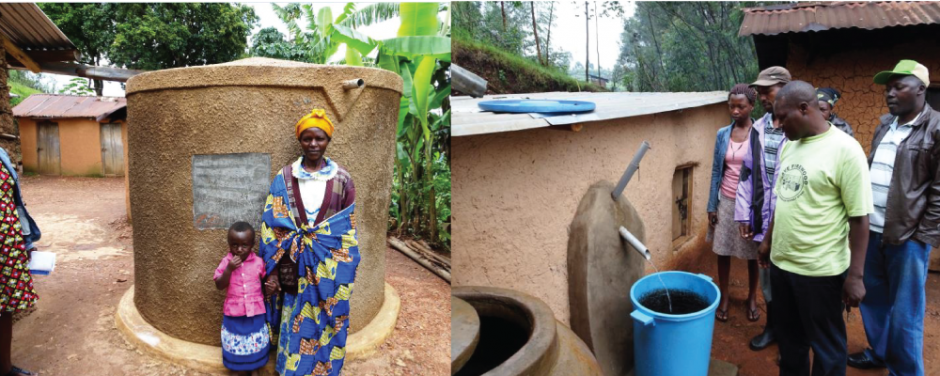
Caritas Kabale Diocese has strengthened farmers’ capacity to tap rain water by supporting construction of 246 tarpaulin walled tanks. These tanks have contributed to increased capacity of households to harvest and store water for a longer period. The proportion of households that get enough water to last for two months have increased from 2% at baseline to 36% by the time of the end-term evaluation. No household reported taping surface run-off for subsequent use. The achievements were well below the performance measure requiring that “at least 70% of the participating households access safe and clean drinking water, for household use and farming requirements” as well as the one demanding that “at least 70% of the households tap run off water”.
Water harvesting tanks. 70 water-harvesting technologies across the 14 sub counties were demonstrated by the trained/ skilled BSPs as artisans to promote adoptions and scale up.
WASH practices promotion.
Door-to-door meetings, dialogue meetings, follow-ups, messages on sanitation improvement in the face of COVID-19 were conducted by the community structures including VHTs, LCs, Bataka and BSPs through campaigns and practices in the communities. 1957 households (91 in Kisoro, 955 in Kanungu, 911 in Rukungiri) that were reached through follow up sessions. They had set up drying racks where they put plates and other utensils to dry before being used for serving meals in order to avoid sanitation related illness, Composite pits, tippy taps and clean latrines places with minimum standards and practiced household hygiene.
Project interventions have catalyzed access to safe, boiled and clean drinking water. Project training of target households on water purification has triggered increase in the proportion of households that boiled drinking water from 40% at baseline to the 87% at mid-term a figure that surpasses the project performance targeted requiring that at least 70% of households boil water for drinking.
Strengthening household capacity on personal hygiene, and sanitation. Although the detailed training on domestic hygiene and sanitation was not yet fully conducted by time of the mid-term evaluation, households and groups have acted on messages related to the subject which staff passingly mention during the other trainings. Consequently, the proportion of households with basic sanitation structures that could be qualified to be called sanitation structures, has increased from 1% at baseline to 73% by the time of the end-term evaluation, figures that meet the project performance target of 70%.
Result 6: At least 46,840 Smallholder farmer families, Kisoro, Kanungu and Rukungiri districts have achieved reduced malnutrition especially children and women of reproductive age.
Caritas with support from USAID has worked with community groups to maximize economic opportunities for vulnerable households stabilize their access to and consumption of diverse and nutritious diets, and increase social capital by reinforcing relationships among formal governance systems and communities.
This has been achieved by Caritas Kabale Diocese through collaboration with community structures such as village health teams (VHTs), Business service providers (BSPs), LC1 chairpersons, Child rights clubs (CRCs) , matrons and patrons, Bataka chairpersons and leaders and other local government personnel.
This was possible through community saving with a purpose (SWAP) groups, Mother Care Groups, Bataka and Ngozi groups focusing on nutrition, agriculture, non-agricultural opportunities, inclusive governance, trainings and demonstrations and formal financial markets and linkages in 14 sub counties of Murora, chahi, Muramba, Bukumbiri and Busanza(Kisoro district), Nyakishenyi, Nyakagyeme, Buhunga, Bwambara(Rukugiri district) and Mpungu, Kirima,Kihihi, Katete and Nyanga in Kanungu district in Kigezi sub region. .
This was achieved through the trainings to equip staff with knowledge and skills to increase on infant nutrition of pregnant and lactating mothers and proper feeding practices for young children under the age of 5 years, using the Mother Care Group model ,mapping and training 224 VHTs (60 in Kanungu, 70 in Kisoro and 57 in Rukungiri) on nutritional related professional trainings, establishing MIYCAN Groups which provide the basis for most of Caritas’ nutrition activities and indicators such as women reached with nutrition/maternal health services, percent of children 6-23 months of age receiving a minimum acceptable diet, pregnant and lactating mothers reached with nutrition interventions information on impacts of larger families, referrals for family planning services.
Promotion of enterprises and practices that enhance minimum acceptable diet & diversity
VHTs taught mothers how to diversify eat balanced diet foods and diversify foods. They held demonstrations on how to use locally available foods to diversify diets and how to access the foods including hunger crops for food security. The demonstrations included set up of the kitchen gardens and food preparation. 3174 households (864 in Kanungu, 1492 in Kisoro and 818 in Rukungiri) established kitchen gardens in their households to diversify their diet.
Result 7: Increased Economic Opportunities for Households
At least 1385 households have improved their economic opportunities as a result of interventions by Caritas strategy of engaging 245 business service providers in Rukungiri ,Kanungu and Kisoro districts,emphasizing VSLA methodology, fee based services and agri-prenuership.
Caritas Kabale Diocese through USAID ICAN Activity has trained 1385 community groups (254 in Rukungiri, 599 in Kisoro and 532 in Kanungu) on VSLA and agriprenuership methodologies.
Credit and saving schemes under seed box approach saving model (VSLAs) have contributed to economic empowerment of local seed business members as LSBs members can easily access financial credit without collateral requirements like in a case with commercial banks to facilitate their seed business like in access of foundation seed and seed business agro in puts for example fertilizers, fungicides/pesticides.
Caritas has facilitated the linkage of Farmer groups for formal agricultural markets. 554 farmer groups with 9120 farmers (males=3277 males and 5843 females) were linked to formal agricultural markets for farm production. Of these, 2138 farmers were linked to agro inputs (seeds, fertilizes and vaccines), 418 members were linked to crop output markets, 124 members. 177 groups were from Kanungu, 296 were from Kisoro and 81 groups were from Rukungiri district.
Linking farmers to formal financial market
The activity reached 4080 farmers in FY2020 with formal financial services. Of these, 1479 farmers were sensitized and introduced to a range of financial products and services and received training on financial literacy. ICAN also supported the opening of 227 bank accounts and 13 individuals accessed credit. These linkages were enhanced by Centenary Bank, Post Bank and DFCU bank, Micro finance support center and SACCOs to increase their visibility and improve access to financial services in rural areas.
Groups Applying Organization-level Technologies or Management Practices. ICAN is supporting groups that have prioritized agricultural livelihoods activities to increase their productivity and ultimately their incomes. In FY2020, ICAN reached 869 groups (458 in Kanungu, 145 in Kisoro and 266 in Rukungiri) that applied organization-level technologies or management practices. These groups include VSLAs and farmer groups, as well as MIYCAN groups across the region. Of these, 216 groups with 6022 members (1683 males and 4339 females) made constitutions and registered with respective sub counties and district local governments.
Result 08: A contribution to reduction in environmental degradation has been made in Kisoro, Rukungiri and Kanungu districts
Promoting climate smart technology and environment. Trained 28 BSPs (14 BSPs for water harvesting tanks and 14 BSPs for Rocket Lorena stoves) on constriction of water harvesting technologies and energy saving stoves.
Rocket Lorena stoves demonstrations. 14 artisan BSPs demonstrated 70 rocket Lorena stoves in ICAN. The trained and artisan BSPs use the demo stoves to create awareness on the importance of stoves in their respective communities. The same approach will be used where by the trained BSP will scale down Rocket Lorena stoves in their respective communities at a
Support to Hill management committees in soil conservation in Kisoro district. Caritas Kabale Diocese collaborated with Mgahinga Craft and Cultural center (MCC) to conserve soils on three hills in Kisoro district. MCC works as contracted has so far trained hill management committees to raise 20,000 bamboo seeds. MCC worked with hill management committees and planted 5000 Bamboo seedlings on Kamenampinga hill to control, soil loss and run off in Murora Sub County in Kisoro district
Caritas Kabale Diocese in collaboration with Sun24, an organisation based in USA, has promoted the use renewable energy technologies through supply of at least 800 Solar lamps at a small user friendly cost of 20,000UGX. This has reduced on the use of petroleum based fuels such as kerosene that emit fumes to the environment and that have effect on the respiratory system of human beings due to the smoke emited.
Result 09: Strengthened Community and Local Governance through supporting in-school activities and engaging community members in local dialogue/governance forums.
(i) Supporting in-school activities.
- 85 primary schools (30 in Kanungu, 25 in Rukungiri and 30 in Kisoro) that are part of the ICAN were supported through journeys curriculum.
- 170 patrons and matrons were trained by ICAN to support 2368 pupils (1076 boys and 1292 girls) on journey’s curriculum. However, activities with Child Rights clubs were affected by the outbreak of COVID-19 that led to the closure of all primary schools.
- 229 pupils (P7 candidates) from primary schools were supported to revise study materials that were distributed by government during lockdown. This engagement will help keep the learners actively engaged and continue with learning while at home in Kanungu and Rukungiri district.
- ICAN participated in 21 school management committee and PTA meeting in Kanungu and Rukungiri district. 1911 community members participated in meetings that focused on most critical actions such as addressing issues like school development, increasing enrolment and encouraging parents to support schools. For instance, in Rukungiri district, ICAN staff participated in parents-teachers association meeting attended at Karyamacumu primary school and presented on activities of ICAN, roles and responsibilities of each stakeholder in the project and its progress in communities.
- Caritas Kabale diocese, with support from Join for Joy in the Netherlands implemented a sports and play program in selected rural primary schools in Kabale and Rubanda districts. The program which started in 2016 with 6 schools has successfully been rolled out to 30 more schools making a total of 36 schools that are benefiting from the program.
- Achievement review:An achievement review, which is the last phase for schools that have done the first two phases, was organized for 06 schools. The schools included, Kiniogo, Kagoye, Kakore, Bwindi, Rwamazuru and St. Johns Ikumba. 24 teachers that attended the were given oral and practical exams to assess their abilities to continue implementation of the program in their schools with minimum external support, or if they still needed capacity building interventions. 06 head teachers of the respective schools attended the workshop to support and confirm practicability of the action plans that teachers made to ensure sustainability of the program in their schools. All teachers passed exams above 60% average.
- Kick off: 06 new schools were selected to benefit from the program. The schools include, Rubira, Kacuro, Nyamabale, Kabanyonyi, Maziba and Kitibya Primary schools. A four - day kick off workshop was organized for 24 teachers at Rushoroza Pastoral center, each school represented by four sports teachers. Game boxes full of an assortment of play materials will be distributed to the above schools .
(ii) Increased participation in community and local dialogue/governance forums.
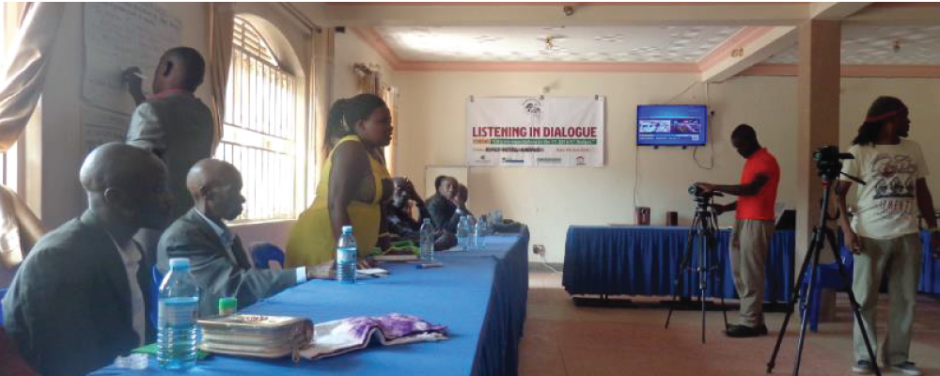
3740 community group members (1136 males, 2604 females) across the 14 sub counties in the three districts have participated in community planning and governance related activities. These included dialogue meetings and Barazas that mainly focused on disaster management, joint community actions against disasters and shocks, the dialogues focused on coming up community and household joint actions on Natural resources management, child protection in homes, gender based violence prevention, food security and WASH interventions.
(iii) Working with the local council leaders on dialogues/ resilience plans and joint action plans
Oriented 253 local leaders (122 in Kanungu, 131 in Rukungiri). The trainings focussed on gender, community mobilization for food and nutrition especially MIYCAN interventions, COVID-19 epidemic guidelines, better WASH practices, saving with a purpose, putting measures to stop early marriages and teenage pregnancies, growing of hunger crops, sending school going children go to school, adoption of MRM technologies especially Tarpaulin walled water harvesting tanks to solve the problem of water and Rocket Lorena stoves or efficient energy use.
(iv) Promoting model Villages
Followed upon the functionality and progress of 28 model villages across the districts. Through ICAN BSPs and VHTs, model villages present an opportunity to engage service providers to do their work. In most model villages, at least 3 milestones of ‘’ICAN to do 5’’ have been achieved including establishment of WASH facilities and kitchen gardens by each household, saving with a purpose and participating in community meetings. The resilience committees in model villages continue to engage households in building resilience capacities against shocks and stresses that affect their community by digging trenches and feeder road opening, ensuring better PHH techniques, sensitizing the communities about the importance of education of their children and food security.
Gender and youth
Result 10: Local seed businesses (LSBs) have been technically equipped, professionally organized, market oriented and strategically linked to achieve commercial sustainability.
Technical trainings in Quality Declared Seed production and marketing for the LSBs are providing a continuous supply of cheap and good quality seed in areas of need. This has contributed to increased income for small-scale farmers and an increased number of rural households that are seed and food secure. These farmer groups produce and sell quality seed of locally preferred crops and varieties to local market and operate as local businesses.
Caritas Kabale Diocese constructed Six (06) modern diffused light stores for Irish potato storage. The LSBs that acquired the modern Diffused light stores under ISSD Uganda infrastructure grant are able to maintain a consistent supply of quality seed to farming communities hence seed security in their areas and surrounding areas.
Result 11: Youth and women are skilled in non-agricultural and agricultural technologies for income diversification.
Caritas Kabale diocese has trained 1150 adolescent girls and young women and equipped them with various skills including catering, petty trade, tailoring, bakery, grocery, art, and craft. Trained 1150 AGYW on AGYW curriculum (658 girls from Kanungu and 492 girls from Kisoro). They are currently engaged petty businesses (catering, petty trade, tailoring, bakery, grocery, casual labor, art, and craft) for income generating activity.
35 women leaders from different parishes and 5 male youth who had been working with Caritas previously in construction of energy saving stoves(Rocket Rolena) totalling to 40participants have been skilled with another model of technology for constructing energy saving stoves of using Molds, elevators and pot rests, the new innovations of which will improve their health, the environment and increase income at group and individual levels as well.
Value addition trainings have been carried out to ensure minimization of post harvest losses at bamper harvests while maximizing profits from the agricultural produce. The skills acquired were on making of crisps, bagia,”ebicepere”and even herbal soap making.
Due to the above training, women are now able to make and pack very well the above products and they testify that they have been able to diversify their income and are now able support their families in various ways. Some active women like Makiro parish are now able to sell herbal soap to the communities within the parish.
100 women and youth in Kabale district and specifically Buhara, Butanda and Rubaya sub counties are skilled in potato and Passion fruits agronomy and can grow these crops all year round due to the adoption of drip irrigation technology in their fields thus improve their income from for passion fruits and Irish potatoes production.
Economic opportunities for the youth and women have been created by organizing them into groups, training them on good agronomic practices for passion fruits and Irish potatoes, equipping them with skills of using simple irrigation technologies for production all year round irrespective of the dry conditions. These interventions were expected to enhance their skills in production for jobs creation and hence increase in their incomes.
Result 12: Gender relations are improved
In at least 3,200 households, gender relations were improved and families live harmoniously, plan together, make important family decisions together and have participatory planning at family level.
Caritas’ project interventions on improving gender relations triggered increased sharing of responsibilities among couples, increased involvement of men in the farm activities notably production of crops for food and income generation; increased participation of women in household decision making due to joint planning and budgeting.
50% of women that we work with Caritas Kabale have been able to take up different leadership roles in groups of men and women. This has helped women to voice our out their views to actively participated in project activities. This in turn has improved on family relations.
With Caritas Japan support, caritas Kabale Diocese has interventions aimed at Promotion of Food and Income Security through Sustainable Agriculture Practices specifically in one sub county called Muko in Rubanda district.
Based on the evaluation findings commendable work has been achieved.
Outcome 1: Improved household Incomes for 200 households in Muko sub county
Indicator 1: Percentage of HHs earning between UGX. 100,000 – 200,000 there is improvement of 6% at the end of year 1 of the project. This has been attributed to the diversification of enterprises like Irish potatoes, beans, sorghum among others
In Kabale Diocese, out of the 200HHs 21% of these are earning between UGX 100,000 – 200,000 per month. In comparison to the baseline values where 15% of the HHs were earning the same amount of money,
Indicator 2: Percentage of HHs that have diversified enterprises
Out of 200HHs, 17% of the target HHs have diversified enterprises (crops, Animals, Poultry, Fish farming, Petty trade among others. In comparison with the baseline values, 1.0% of the target HHs had diversified enterprises. So there is a progress of 16% by the end of year 1 of the project. This because farmers are now able to access some funds from the group as loans to use in other in other income generating activities.
Indicator 3: Percentage of HHs which are able to support their children in school
Out of 200 HHs, 26.5% of the target HHs are able to support their children in schools. In comparison with the baseline survey values, 18.5% of the target HHs had their children in school; therefore, there is a progress of 8% at the end of year 1 project implementation.This is attributed to diversification of enterprises and saving at group level where people are able to borrow some money for school fees.
Indicator 4:Percentage of HHs that are participating in VSLA
Out of 200 HHs, 100% of the target HHs are participating in VSLA. In comparison with the baseline survey values, 76% of the target HHs were saving with VSLA, hence there is a steady progress of 24% concerning savings at the end of this year, meaning that all the group members participate in village savings
Outcome 2: Improved crop yields among target HHs
Indicator 1: Beneficiaries that have adopted at least 3 good agricultural practices (agronomic practices, soil and water conservation, soil fertility management, IPM etc)
In Kabale Diocese, out of 200HHs 81% of the target HHs have adopted at least 3 good agricultural practices, In comparison with the baseline survey values, 2.1% of the target HHs had adopted at least 3 agricultural practices, thus there is a steady progress of 77.9% of HHs practicing at least 3 good agricultural practices practiced in this year 2018.
Indicator 2: Percentage of HHs that have enough crop harvests for both home consumption and for sale
Out of 200 HHs, 3.3% of the target HHs have enough crop harvests for both home consumption and sale. In comparison with the baseline survey, 3.2% of the target HHs had enough crop harvests for both home consumption and sale, thus there is slight progress of 0.1%. And this is attributed to floods that swept farmers gardens and the unexpected dry spell that resulted into poor crop yields.
Outcome 3: Improved food and nutrition Security among target HHs
Indicator 1: Percentage of HHs able to eat at least 3 meals per day
Out of the 200 HHs, 1.7% of the target HHs are able to eat 3 meals per day. In comparison with the baseline survey, 9.0% were able to eat at least 3 meals per day; therefore, there is a general decline of 7.3% of HHs which are able to eat 3 meals per day. This is due to climatic changes which led to poor yields leading to households having less than 3 meals per day.
Indicator 2: Percentage of HHs that have at least 3 varieties of vegetables in their kitchen gardens and at least 3 varieties of fruit trees
Out of 200 HHs, 25.5% of the target HHs has at least 3 varieties of vegetables and fruit trees. In comparison with the baseline survey values, 29.5% had vegetables and fruit trees in their homes; thus there is a decline of 4% because the other improved varieties of vegetables are still on the nursery beds to be planting in the next phase.
Indicator 3: Percentage of HHs able to store food for the month of scarcity
Out of 200 HHs, 21.7% of the target HHs are able to store food for the month of scarcity. In comparison with the baseline survey results, 10% of the target HHs were able to store food for the months of scarcity; therefore there is a progress of 11.7% HHs that are able to store food for the month of scarcity at the end of this year. This has been attributed to crop diversification hence able to store some food for the month of scarcity.
Outcome 4: Improved environmental conservation among target HHs
Indicator1: Percentage of HHs with at least 3 standard home hygiene and sanitation structures (Toilet, Drying rack and bath shelter)
Out of 200 HHs, 24.2% of the target HHs have at last 3 standard hygiene and sanitation structures. In comparison with the baseline survey values, 1.01% had at least 3 standard hygiene and sanitation structures; hence there is a progress of 23.2% due to caritas intervention through sensitizations, trainings and follow up activities by the staff.
CHALLENGES ENCOUNTERED IN 2020
• Late disbursement of funds in some projects. This led to delays in payment of staff remunerations and administrative costs thereby demoralizing project work. The issue affected activities especially VHTs and BSPs who are expected to submit data into the system
• Inadequate support from government stakeholders as result of scrapping off allowances for government stakeholders during activity implementation especially USAID ICAN activities.
• The COVID 19 pandemic paralysed the activities since transport and social gatherings were limited and this affected the implementation of some activies as had been earlier planned.
• Landslides still posed a threat to soil fertility. Much as water retention trenches were constructed, landslides still water washed down crops when the rains were abnormally heavy.
• Disease outbreaks especially for goats and pigs. This attracted in a quarantine applied to the pig business in Kabale district.
• Water harvesting technology challenges; Not all members received water tanks; water availability remains a challenge to those who had no tanks and pumping system breaks down quite often due to misuse by the children and neighbours.
• The closure of Uganda –Rwanda border impaired the movement of goods especially the agricultural produce. This led to decline in the market for potato seeds and also ware potato. This also forced farmers to sell the produce cheaply to local vendors.
• Low dietary diversity remains a challenge in the project area with majority (69%) of the households eating food from fewer than five out of seven food groups (cereals/tubers, pulses/nuts, vegetables, fruits, milk, meat/fish/eggs, and oil)
• Volume of savings is still small hence limiting farmer access to adequate credit amounts. Groups still lack the financial muscle to enable them expand their business operations.
PICTORIAL REPORT OF THE PROJECT ACHIEMENTS 2020